ABOUT ME
I am a PhD-trained computational cognitive neuroscientist with advanced expertise in AI, machine learning, deep learning and cognitive neuroscience. My mission is to harness cutting-edge technology to address real-world challenges and drive innovation in Deep tech at the intersection of neuroscience, and cognitive science, and computer science. I’m currently fulfilling this as Senior Data Scientist in the Biomarker Ideation Team @SOMA.
My previous experience includes a research stay at Harvard University and working as Data Science Consultant in the public sector for Capgemini Invent creating and for CorrelAid.
I am deeply passionate about applying my advanced analytical and communication skills to create meaningful impact in real-world applications.
Below I want to highlight some of my previous projects including a project from my PhD, my research visit at Harvard, and from my time as Data Science consultant @CorrelAid. You can find more details on my PhD projects in my
Lab-books!
SELECTED PROJECTS
Reading Your Mind
Sounds like science-fiction? Nope! We can use Machine-Learning to predict what people are looking at, imagining, or “thinking” based on activation patterns in neural recordings (in this case EEG). Using cross-decoding (training a classifier on a subset of the data and testing how it generalises to unseen data), we can probe the similarity in neural activation patterns when people view images of different household objects. Why? To test whether how objects cluster together in the real world is reflected in how the brain processes visual input – bringing us closer to understanding how as humans we perceive our surroundings so effortlessly.
Where & When: Goethe University, Frankfurt, Germany, 2024
Tools used: Python, Pytorch, scikit-learn, Huggingface, Large-Language-Models, mne
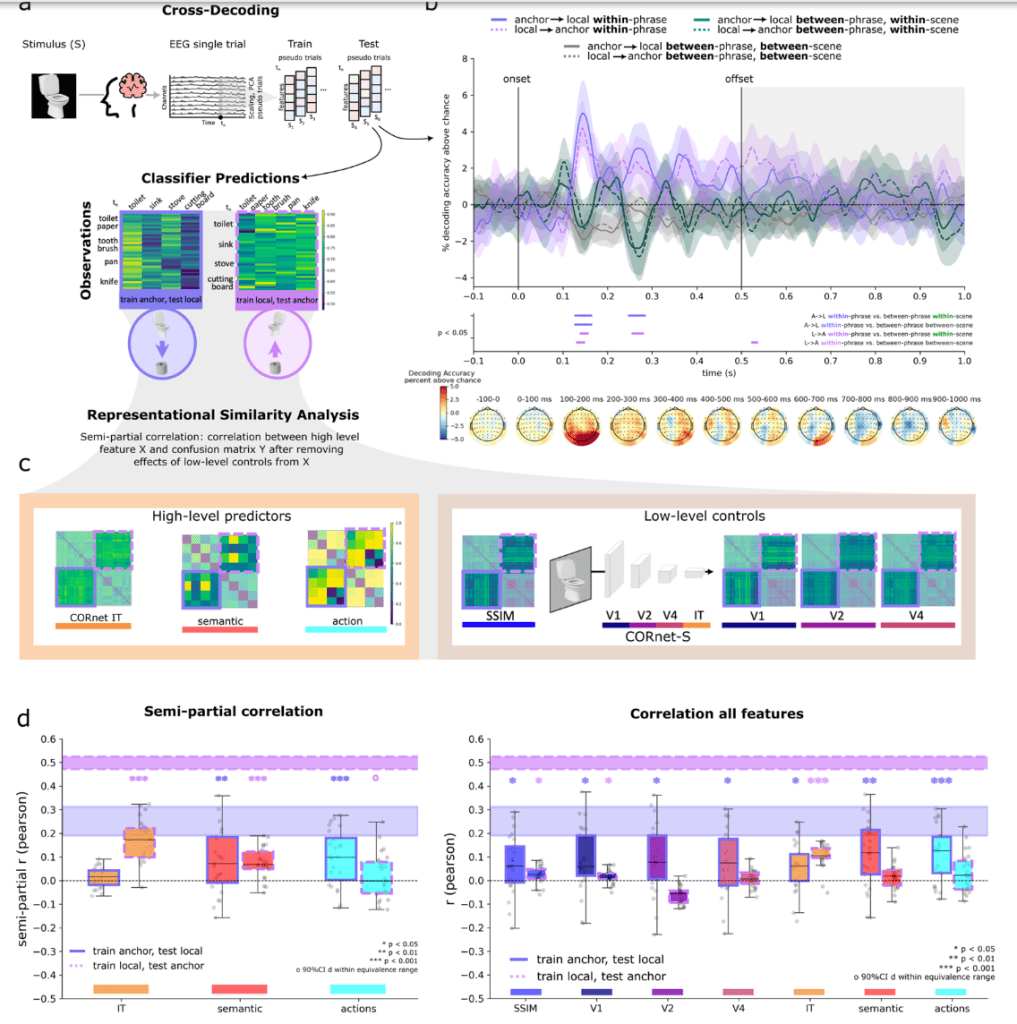
Check out the preprint and Github repository:
Representational Trajectory Analysis
Do deep neural networks trained on images of objects, faces, or scenes represent images similarly as information propagates through the layers? In this project we developed a “representational trajectory analysis” to answer this question. Check out the video below for more details.
Where & When: Harvard Vision Lab, Cambridge, USA, 2019
Tools used: Python, PyTorch
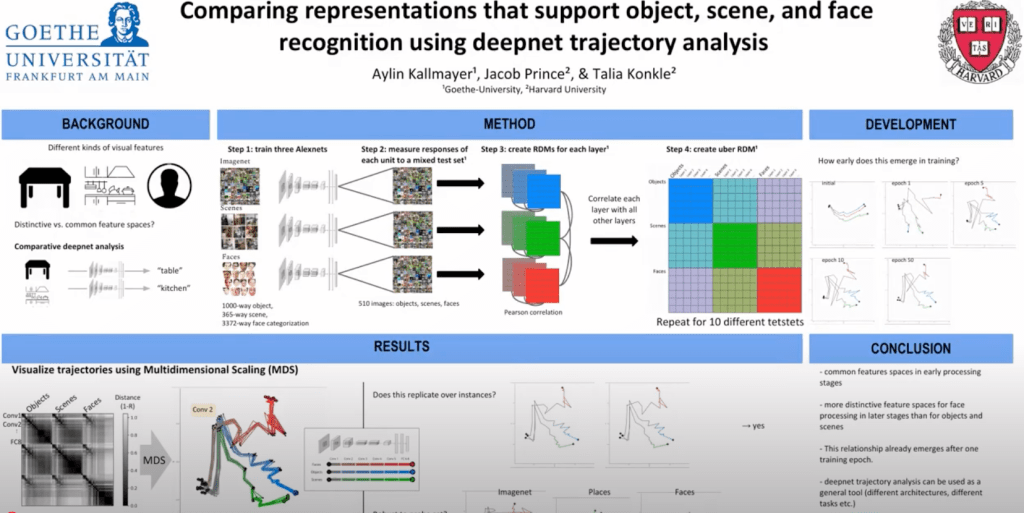
See this video for details on background, methods, and results.
CorrelAid – VOTO
As Data Science Consultant for CorrelAid I analysed user data from the Komunat 2019 (now VOTO) online voting assistant. I built predictive models linking user data to election results and created interactive dashboards to visualise candidate performance and candidate-user alignment.
Where & When: Remote, 2020-2021
Tools used: R, Rshiny, Python
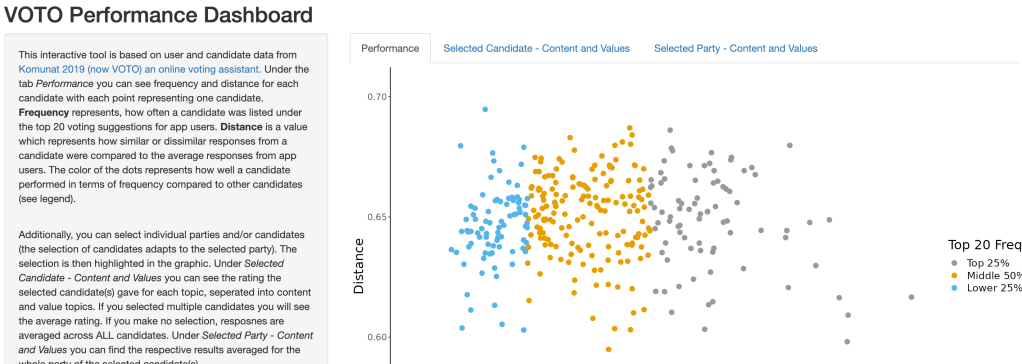
Click below to launch one of the dashboards visualising candidate performance amongst app users.
 Aylin Kallmayer